Sony Walkman: The Device That Made Music Personal

Before algorithms curated playlists and phones absorbed every object we carried, there was a blue rectangle with orange foam headphones that quietly changed culture.
The Sony Walkman was never just a music player.
It was one of the most influential pieces of industrial design ever created.
The Beginning of Portable Listening
In 1979, Sony released the first Walkman, the TPS-L2. At a time when music was tied to living rooms, speakers, and shared spaces, Sony introduced a radical idea:
What if music became personal?
The Walkman allowed people to move through cities with a soundtrack of their own choosing. Suddenly, commuting, running, waiting, and wandering became cinematic experiences.
Today that feels normal.
Back then, it changed behavior.
Sony didn’t invent recorded music or headphones. They designed a new relationship between humans and technology.
Why the Walkman Design Became Iconic
Great industrial design disappears into experience.
The Walkman succeeded because every design decision served a feeling:
Compact enough to carry everywhere
Mechanical buttons with satisfying tactile feedback
Bright accents and approachable materials
Clear visual hierarchy
Instantly recognizable silhouette
The iconic blue-and-orange aesthetic wasn’t accidental.
Sony made technology feel human.
Unlike many electronics of the era that looked technical and intimidating, the Walkman looked optimistic.
It invited interaction.
The cassette window gave users a visible connection to the medium—watching tapes spin became part of the experience itself.
From Cassette to CD to MP3
Sony understood early that portable audio wasn’t a product category.
It was a lifestyle.
Over time, Walkman evolved:
Cassette Walkman
Portable analog listening became a cultural movement.
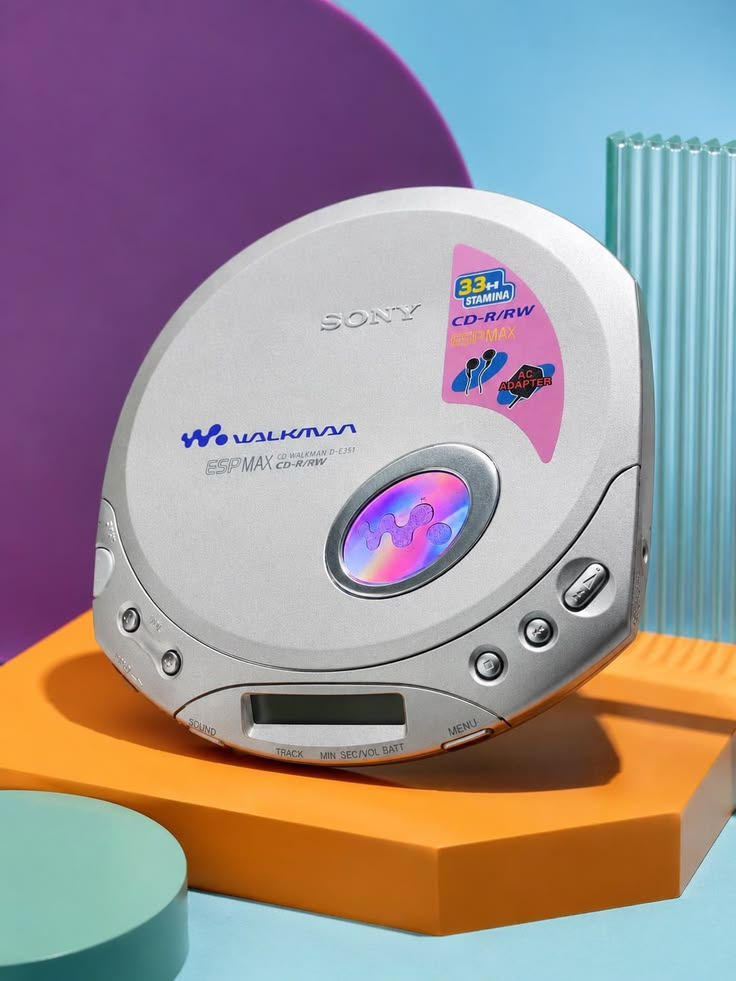
Discman Era
Compact discs promised cleaner sound and digital convenience.
Network Walkman & MP3 Players
As digital audio emerged, Sony entered the MP3 era with sleek, premium devices focused on sound quality and design.
Models like the NW series experimented with minimalist interfaces, aluminum bodies, dedicated controls, and battery-first thinking long before smartphones became dominant.
The MP3 Era: Beautiful Hardware, Difficult Timing
Sony’s MP3 players often looked better than the competition.
Thin profiles.
Premium finishes.
Excellent physical controls.
But timing matters.
While Sony focused heavily on proprietary ecosystems and protected formats, competitors embraced simpler syncing and expanding digital ecosystems.
The lesson wasn’t about sound quality.
It was about experience design.
Great industrial design cannot compensate for friction.
What Designers Can Learn from the Walkman
As a graphic and product designer, I keep coming back to the Walkman because it solved something deeper than portability.
It created emotion.
The best products don’t only perform tasks.
They create rituals.
Press play.
Flip the cassette.
Rewind.
Change sides.
Carry your soundtrack.
The Walkman transformed listening into an experience people remember decades later.
And that’s why its influence still appears in modern interfaces, wearable devices, and even the way we design digital products today.
Technology changes.
Objects disappear.
But great design changes behavior.
And that’s why the Sony Walkman still matters.



Comments